Research
Liquid-vapor interfaces are everywhere in natural and engineered systems: the cup of coffee on your desk, the tree outside, the AC unit indoors. All of them have liquid-vapor interfaces undergoing some form of evaporation. Curved interfaces such as droplets, bubbles, and menisci are especially interesting because surface tension gives them distinct properties that change how evaporation proceeds. The evaporation in turn deforms and moves the interface. This two-way coupling is most important when surface tension is the dominant force, as in the microgravity of space or in micro- and nanoscale devices on Earth.
At UCLID, we study multiphase transport using visualization, theory, and multiscale modeling, from molecular dynamics through continuum CFD. Our work spans nano- and microscale heat transfer (thin film evaporation, boiling, condensation, electronics cooling), cryogenics and hydrogen, space technology (variable-gravity fluid management), porous media transport, and advanced manufacturing. Liquid-vapor interfacial dynamics ties all of these together.
Core capabilities
- Multiscale modeling: molecular dynamics → kinetic theory → thin-film models → CFD, coupled so that interface physics is predicted rather than tuned.
- Optical & interfacial diagnostics: interferometry, ellipsometry, optical microscopy, high-speed imaging, and contact angle/wettability measurement.
- Extreme-environment experiments: neutron imaging of cryogenic liquid hydrogen and methane, and analysis of microgravity data from the International Space Station.
- Data-driven sensing: acoustic signatures, signal and image processing, and machine learning to identify flow regimes and interfacial events.
Current research thrusts are listed below. Please contact Prof. Bellur for an updated list, or see Industry Collaboration for ways to work with us.
Measuring and modeling how liquid hydrogen and methane evaporate, condense, and wet surfaces. We use neutron imaging to see through metal containers at cryogenic temperatures, and we build predictive models that don’t need tuning coefficients.
Using data from the Constrained Vapor Bubble experiment on the International Space Station to test assumptions that phase change models routinely make. Without gravity, surface tension and Marangoni flow take over, and the interface physics is easier to see.
Simulating individual molecules crossing a liquid–vapor interface, so the parameters that continuum models usually guess can be calculated from first principles.
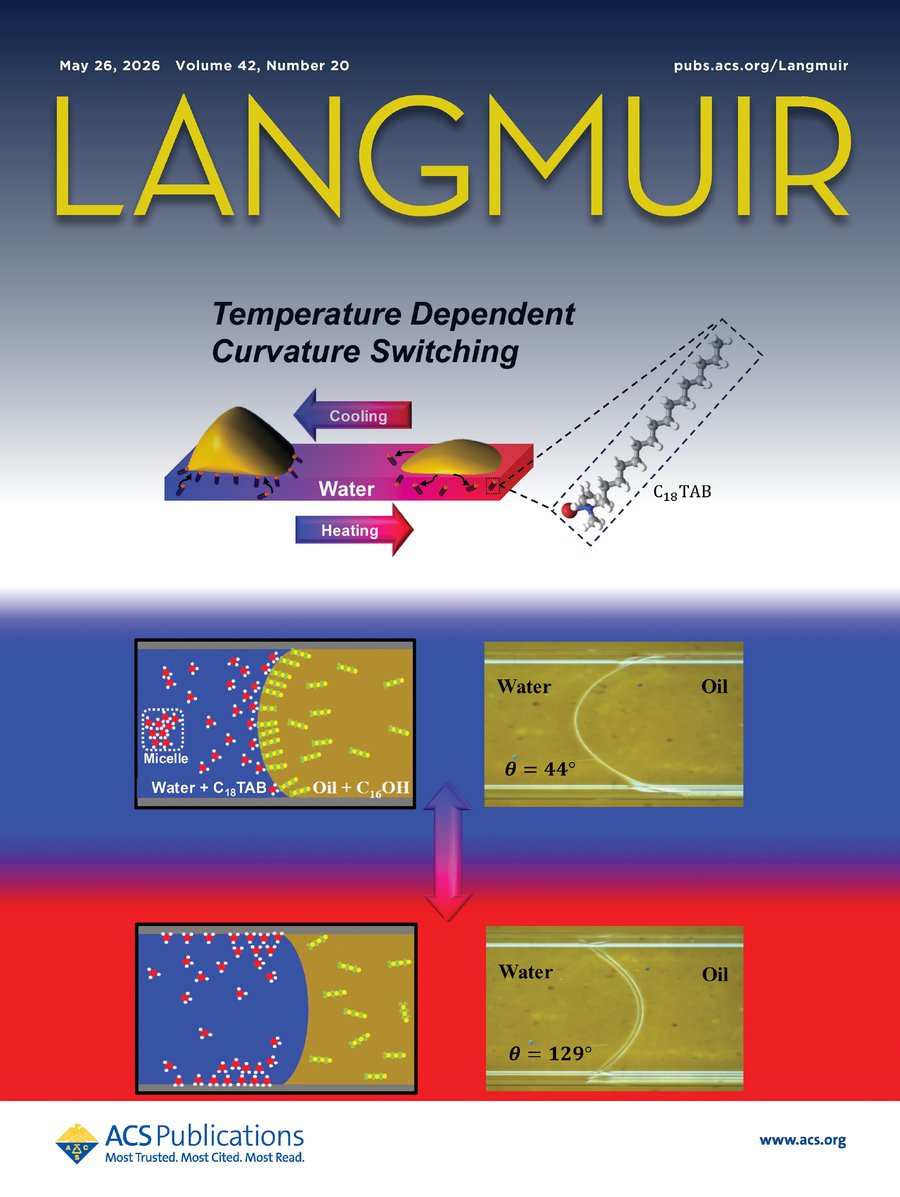
Controlling how liquids move through porous materials by adjusting wettability. Thermally responsive surfactants make it possible to switch flow regimes at the pore scale with a change in temperature.
Most of the heat transfer during evaporation happens in a liquid film only nanometers to micrometers thick, near the contact line. We model and measure how these films evaporate, oscillate, and destabilize.
Listening to boiling and condensation. We use acoustic signatures to identify two-phase flow regimes and to warn of critical heat flux without needing optical access.
Switching the shape of an oil–water meniscus on demand. Using temperature-sensitive surfactants, we can reversibly flip a meniscus between concave and convex with a small temperature change. This work was featured on the cover of Langmuir.