Page Not Found
Page not found. Your pixels are in another canvas.
A list of all the posts and pages found on the site. For you robots out there is an XML version available for digesting as well.
Page not found. Your pixels are in another canvas.
This is a page not in th emain menu
Published:
Whether I’m teaching Thermodynamics or Computational Fluid Dynamics, I see the same pattern. Students who miss one step, such as setting up an energy balance or following a stability argument, rarely say so in the moment. By the time it shows up on an exam, several weeks of material have piled on top of it. This summer I built two tools to close that gap. Both are freely available and live on the Teaching page.
Published:
I’m grateful to receive the Neil Wandmacher Teaching Award for Early Career Faculty from the College of Engineering and Applied Science.
Published:
Our paper An Experimental Study of Interfacial Dynamics Control Using Temperature-Sensitive Surfactants is out in Langmuir, and it was selected as a cover article for the May 26, 2026 issue (Vol. 42, No. 20)!
Published:
UCLID students have collected a remarkable set of competitive awards over the past several months:
Published:
Our paper Slug Flow Condensation Identification with Acoustic Signatures is now published in the International Journal of Heat and Mass Transfer.
Published:
At the 11th Thermal and Fluids Engineering Conference, UCLID presented two talks on the dynamics of evaporating thin films:
Published:
Congratulations to Unmeelan Chakrabarti on successfully defending his PhD dissertation, “A multiscale investigation of simplifying assumptions made during liquid-vapor phase change modeling.”
Published:
UCLID traveled to ASME IMECE 2025 with three talks, all on our thin-film and multiscale phase change work:
Published:
This fall brought two new publications from UCLID students.
Published:
Unmeelan’s second paper analyzing International Space Station experiments is now out in Nanoscale and Microscale Thermophysical Engineering: Investigating the Inequality of Phase Change Coefficients Using ISS Experimental Data.
Published:
| Date | Event |
|---|---|
| 08/20/2025 | Unmeelan’s second paper on analysis of ISS experiments is now available! |
| 05/17/2025 | Prof. Bellur gave an invited talk at Oregon State University, Corvallis, OR (host: Prof. Andy Dong). |
| 05/13/2025 | We received the 2025 Gold Star Lab Award from the College of Engineering and Applied Science. |
| 05/07/2025 | Congratulations to Saaras for being selected to receive the 2025 Armstrong Fellowship for Discovery! |
| 05/01/2025 | Prof. Bellur gave an invited talk at Hokkaido University, Japan (host: Prof. Yutaka Tabe). |
| 03/12/2025 | Amirhosein led a team that won 1st place in the ASTFE Green Energy CFD Competition. |
| 03/11/2025 | Amirhosein and Ayaaz presented their work at the ASTFE conference. |
| 02/17/2025 | Prof. Bellur gave an invited talk at Ericsson, Sweden. |
| 02/11/2025 | Prof. Bellur gave an invited talk at Miami University, Oxford, OH (host: Prof. Andrew Sommers) |
| 12/04/2024 | Unmeelan successfully defended his PhD proposal and advanced to PhD candidacy! |
| 11/19/2024 | Unmeelan presented a talk at ASME IMECE and won the Outstanding Student Presentation Award! |
| 11/11/2024 | Prof. Bellur gave an invited seminar talk at Southern Methodist University (host: Prof. Ali Beskok). |
| 10/30/2024 | Prof. Bellur gave an invited seminar talk at Embry-Riddle Aeronautical University (host: Prof. Sandra Boetcher). |
| 08/28/2024 | Unmeelan and Ayaaz presented their work at the NASA Thermal Fluids and Analysis Workshop (TFAWS). |
| 05/30/2024 | Congratulations to Sandeepan on a successful MS thesis defense! |
| 05/29/2024 | Ayaaz successfully defended his MS thesis and will continue at UCLID as a PhD student. |
| 05/10/2024 | Tejas successfully defended his MS thesis. Congratulations! |
| 05/06/2024 | Congratulations to Manjeera on a well-executed PhD dissertation defense! |
| 04/21/2024 | Prof. Bellur presents a talk on cryo/neutron experiments at ASTFE 2024 |
Published:
This spring I had the chance to share UCLID’s work with a wide range of audiences in academia and industry:
Published:
We are honored to receive the 2025 Gold Star Lab Award from UC’s College of Engineering and Applied Science.
Published:
UCLID had a strong showing at the 10th Thermal and Fluids Engineering Conference (ASTFE).
Published:
Congratulations to Unmeelan Chakrabarti, who won an Outstanding Student Presentation Award at ASME IMECE 2024 for his talk “Investigating the sensitivity of inequal evaporation and condensation coefficients during liquid vapor phase change using data from Constrained Vapor Bubble (CVB) experiments conducted in the International Space Station (ISS).”
Published:
The 2023 Division of Fluid Dynamics Annual Meeting of the American Physical Society, held in Washington, DC, was a melting pot of innovative ideas and groundbreaking research. Our lab was thrilled to be a part of the event, where our student, Ayaaz Yasin, presented a talk on “A Numerical Study of Coefficient-free Kinetic Evaporation Modeling in Liquid Hydrogen” during Mutliphase Flows: Computational Methods session.
Published:
We are happy to present our latest publication on analysis of the Constrained Vapor Bubble (CVB) experiment on the International Space Station (ISS).
Published:
While we have had a formal UC website, it was time to revive my defunct personal website and transform it into a group website. Historically, I have refrained from “posting” anything on a public form. I’ve realized I need to overcome this and what better way than to put my students front-and-center and empower them to post updates while learning to use git effectively and maintain the site. As with a lot of things we do at UCLID, this is an experiment that will evolve with time and group interests but I hope that this becomes a productive (and fun) exercise that keeps the website more active.
PhD Student, 2023 - present.
Porous Media, Two-Phase Flow, Thermal Management, Li-ion Battery, Optical Microscopy
PhD Student, 2022 - present.
Computational Fluid Dynamics, Multiphase Flows, Phase Change Modeling, Molecular Dynamics
BS Alum, May 2024 - August 2024.
Sensor Design and Calibration, Control Systems, CAD Modeling, 3D Printing
BS Student, 2025 - present.
Fluid Mechanics, Signal and Image Processing, Optics
MS Alum, 2021 - 2022.
MS Thesis, "Thin Film Evaporation Modeling of the Microlayer Region in a Dewetting Water Bubble", 2022. Currently R&D Test Engineer at FERNO.
BS Alum, Fall 2025 - Spring 2026.
Undergraduate researcher, 2025–2026. 1819 Innovation Award winner.
Principal Investigator, 2021 - current.
10+ years of experience in phase change heat transfer, capillary phenomena, cryogenics and scientific computing
PhD Alum, 2016 - 2024.
PhD Dissertation, "Design and Investigation of a Hydraulic Milli-Actuator for Minimally Invasive Medical Applications", 2024. Currently Project Manager at Ethicon (J&J MedTech).
BS Alum, 2024 - 2026.
Undergraduate researcher, 2024–2026, with 2 journal publications (1 first-author). Currently a PhD student at Rice University.
MS Alum, 2021 - 2024.
MS Thesis, "Optical Transmission through Sessile Water Droplets Undergoing Solidification, and the Effect of Hydrophobicity", 2024. Currently at IIT Bombay.
PhD Student, 2025 - present.
Multiphase flows, Fluid Mechanics, Heat & Mass Transfer
MS Alum, 2022 - 2024.
MS Thesis, "Experimental and Numerical Investigation of Isothermal Bubbling in Shear-thinning Liquids", 2024. Currently at Johnson Controls.
BS Alum, May 2026 - August 2026.
Summer 2026 REU student from Tennessee Tech. Currently co-authoring a paper.
PhD Alum, 2022 - 2026.
PhD Dissertation, "A multiscale investigation of simplifying assumptions made during liquid-vapor phase change modeling", 2026. Currently Senior Mechanical Development Engineer at Virginia Transformer Corp.
MS Alum, 2023 - 2025.
MS Thesis, "Contactless Cleaning using Leidenfrost Droplets", 2025.
Journal of Heat Transfer, 2015.
Use Google Scholar for full citation
Journal of Flow Visualization and Image Processing, 2016.
Use Google Scholar for full citation
Journal of Heat Transfer, 2016.
Use Google Scholar for full citation
Cryogenics, 2016.
Use Google Scholar for full citation
Journal of Heat Transfer, 2016.
Use Google Scholar for full citation
Journal of Heat Transfer, 2018.
Use Google Scholar for full citation
Cryogenics, 2018.
Use Google Scholar for full citation
Soft Matter, 2019.
Use Google Scholar for full citation
ECS Transactions, 2019.
Use Google Scholar for full citation
Nanoscale and Microscale Thermophysical Engineering, 2020.
Use Google Scholar for full citation
Physical Review Fluids, 2020.
Use Google Scholar for full citation
Cryogenics, 2022.
Use Google Scholar for full citation
Data in Brief, 2022.
Use Google Scholar for full citation
Frontiers in Space Technologies, 2023.
Use Google Scholar for full citation
Fluids, 2023.
Use Google Scholar for full citation
Colloids and Surfaces A: Physicochemical and Engineering Aspects, 2023.
Use Google Scholar for full citation
Micromachines, 2023.
Use Google Scholar for full citation
Applied Thermal Engineering, 2023.
Use Google Scholar for full citation
Micromachines, 2024.
Use Google Scholar for full citation
Journal of Flow Visualization and Image Processing, 2025.
Use Google Scholar for full citation
Journal of Turbomachinery, 2025.
Use Google Scholar for full citation
Discover Mechanical Engineering, 2025.
Use Google Scholar for full citation
Nanoscale and Microscale Thermophysical Engineering, 2025.
Use Google Scholar for full citation
Applied Thermal Engineering, 2025.
Use Google Scholar for full citation
Fuels, 2026.
Use Google Scholar for full citation
International Journal of Heat and Mass Transfer, 2026.
Use Google Scholar for full citation
Langmuir, 2026.
Cover article. Open access (CC-BY): read the paper here.
Colloids and Surfaces A: Physicochemical and Engineering Aspects, 2026.
Use Google Scholar for full citation
Measuring and modeling how liquid hydrogen and methane evaporate, condense, and wet surfaces. We use neutron imaging to see through metal containers at cryogenic temperatures, and we build predictive models that don’t need tuning coefficients.
Using data from the Constrained Vapor Bubble experiment on the International Space Station to test assumptions that phase change models routinely make. Without gravity, surface tension and Marangoni flow take over, and the interface physics is easier to see.
Simulating individual molecules crossing a liquid–vapor interface, so the parameters that continuum models usually guess can be calculated from first principles.
Controlling how liquids move through porous materials by adjusting wettability. Thermally responsive surfactants make it possible to switch flow regimes at the pore scale with a change in temperature.
Most of the heat transfer during evaporation happens in a liquid film only nanometers to micrometers thick, near the contact line. We model and measure how these films evaporate, oscillate, and destabilize.
Listening to boiling and condensation. We use acoustic signatures to identify two-phase flow regimes and to warn of critical heat flux without needing optical access.
Switching the shape of an oil–water meniscus on demand. Using temperature-sensitive surfactants, we can reversibly flip a meniscus between concave and convex with a small temperature change. This work was featured on the cover of Langmuir.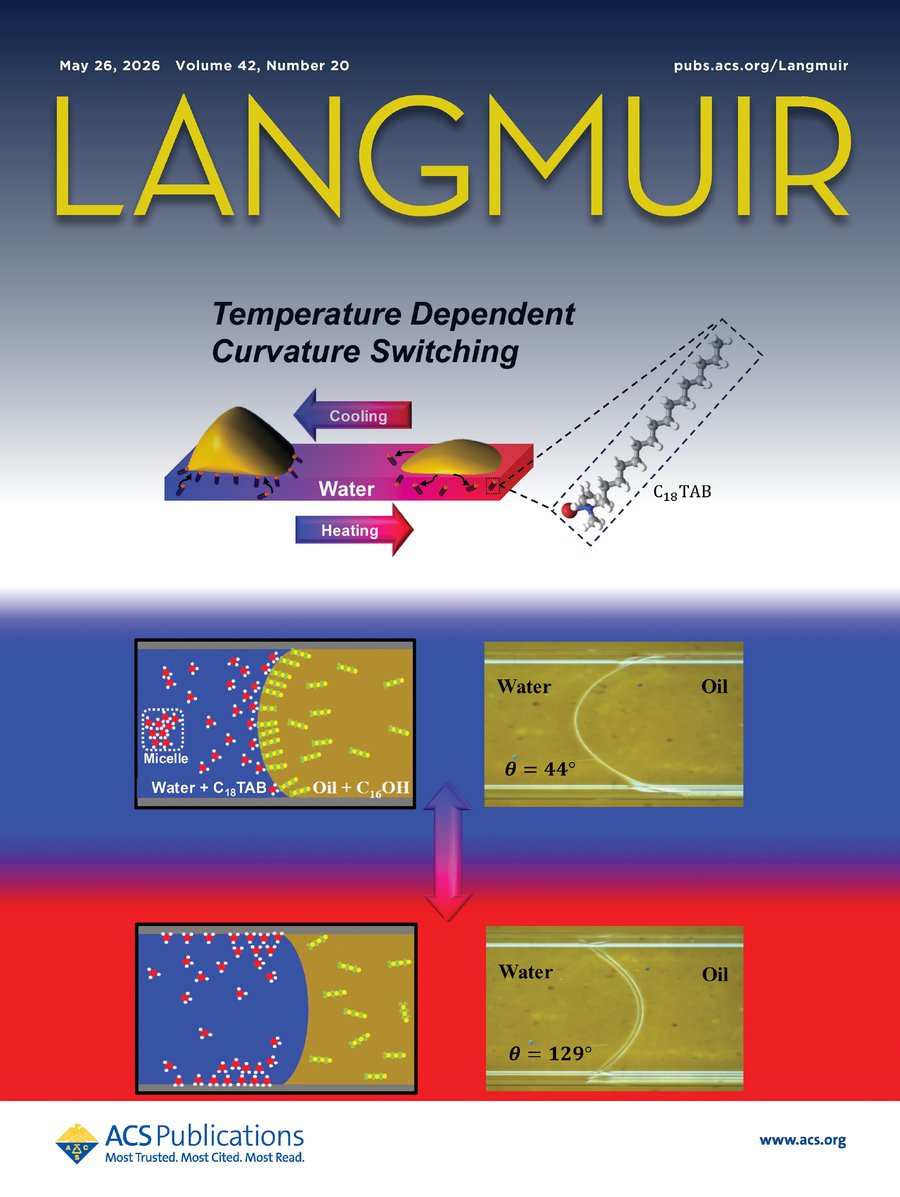
Published:
The presentation focused on the setup and preliminary images from a feasibility campaign. This was the first time neutron images of evaporating liquid hydrogen was presented. The presentation resulted in a journal article published in Journal of Heat Transfer
Published:
NASA Early Stage Innovation Workshop on Measuring Accommodation Coefficients.
Published:
The graduate research colloquium is an opportunity to share student research with the university community and gain experience in presenting in a conference style setting.
Published:
The presentation focused on the development of a new experimental method to determine accommodation coefficients. The ability to visualize liquid hydrogen was emphasized The presentation resulted in a journal article published in Cryogenics
Published:
Contact angles of liquid hydrogen as measured by neutron image analysis were discussed.
Published:
Wettability of hydrogen is investigated through neutron image processing using a conical cell and results discussed. The presentation resulted in a journal article published in Journal of Heat Transfer
Published:
A poster presented to the chemistry community emphasizing the applicability of using neutron imaging to understand fundamental surface science.
Published:
The poster presentation won a 3rd place award in the graduate student category!
Published:
Kishan Bellur received a scholarship to travel/attend/present at this workshop. The presentation resulted in a journal article published in Cryogenics
Published:
The presentation resulted in a journal article published in Journal of Heat Transfer
Published:
The presentation focused on the ability to to combine experimental data with computational modeling to obtain the accommodation coefficients. Experimental data and progress on the modeling framework was presented.
Published:
Kishan Bellur received the best oral presentation award!
Published:
IMA workshop on Dynamic Contact Lines: Progress and OpportunitiesâÂÂ. Kishan Bellur received travel support to attend/present at this workshop.
Published:
Invited by Prof. Mark Weislogel
Published:
Invited by Prof. Jaroslaw Drelich.
Published:
The poster highlighted neutron imaging as an ideal probe to visualize cryogenic propellant phase change. Importance and applications of the accommodation coefficient of cryogenic propellants were discussed.
Published:
Invited by Prof. Jaroslaw Drelich. Panel discussion with Jessica Brassard and Allison Hein.
Published:
The first estimates of the accommodation coefficient(s) for liquid hydrogen were presented. Kishan Bellur won the best poster award!
Published:
The cryo-neutron experiments were presented in detail and the modeling effort was introduced briefly. The supplementary GRC talk addressed the model and the accommodation coefficients.
Published:
The multi-scale modeling methodology and the accommodation coefficients for liquid hydrogen and methane were discussed in detail. The supplementary GRS talk addressed the cryo-neutron experiments.
Published:
The stability of thin liquid films was discussed from the context of liquid-vapor phase change. A new scaling analysis was presented.
Published:
This presentation to the local Houghton community included an outdoor model rocket launch demonstration.
Published:
The complete cryo-neutron story is presented in an integrated modular approach. The experiments, thermal transport analysis and multi-scale evaporation modeling are combined to generate the accommodation coefficients for both hydrogen and methane. The resulting values are independent of both container material and size and agree well with a fluid independent transition state theory prediction.
Published:
Invited by Prof. K. T Vasudevan
Published:
Published:
Invited talk for the Dept of Mechanical and Materials Enineering graduate seminar
Published:
A pdf of the poster is avilable here
Published:
This presentation highlights Marangoni flow along the interface resulting in a complex wavy flow pattern. Steps toward determining phase change coefficients are discussed.
Published:
Published:
A custom thin-film evaporation model was developed to describe the microlayer region of a dewetting water bubble. The model incorporates high spatio-temporal resolution film thickness and temperature measurements and shows the mass flux non-uniformity in the microlayer region during the dewetting process.
Published:
We use our thin film modeling in conjunction with high resolution experimental data to show that the evaporation coefficient is not a constant but varies with time/thermophysical properties during the ebullition process.
Published:
The cryo-neutron dataset was used in conjunction with our multiscale evaporation model to show that the interface is non-isothermal. Most studies in the past have assumed an isothermal interface based on equilibrium arguements leading to the discrepency in reported values. We showed that accounting for non-uniformity in temperature and pressure results in a predictable coefficient.
Published:
Results and lessons from the cryo/neutron experiments were presented in detail in this 30 min lecture. The non-isothermal / non-equilibrium nature of the phase change process and its implication in reported coefficient values were discussed.
Published:
Published:
Published:
Workshop, Michigan Technological University, 2018
Undergraduate course, Michigan Technological University, 2019
In the spring semester of 2019, Dr. Bellur taught his first ever course as primary instructor: a 4 credit junior level undergraduate course in thermo-fluids. This unique course focused on fundamentals and applications of fluid mechanics and heat transfer to fluid flow in ducts and pipes (internal flow). Concepts from fluid mechanics and heat transfer were taught simultaneously in an integrated thermal-fluids approach.
Undergraduate/Graduate course, University of Cincinnati, 2026
EGFD 5137/6037, taught every spring and rebuilt from scratch in 2022. Students write their own solvers, then complete an individually scoped, semester-long project run like a real conference cycle (abstract, presentation, paper). Several projects have gone on to conference and journal publications, and one grew into a full thesis.
Undergraduate course, University of Cincinnati, 2026
MECH 2010, taught every fall. A required second-year course redesigned around group problem-solving and open-ended design projects. It uses a gamified zyBooks platform with custom content Prof. Bellur helped build, live LecturePulse feedback, and a pilot of SAM, an AI study assistant grounded in the course’s own lectures.