
Oil-Water Interfacial Dynamics
Why it matters
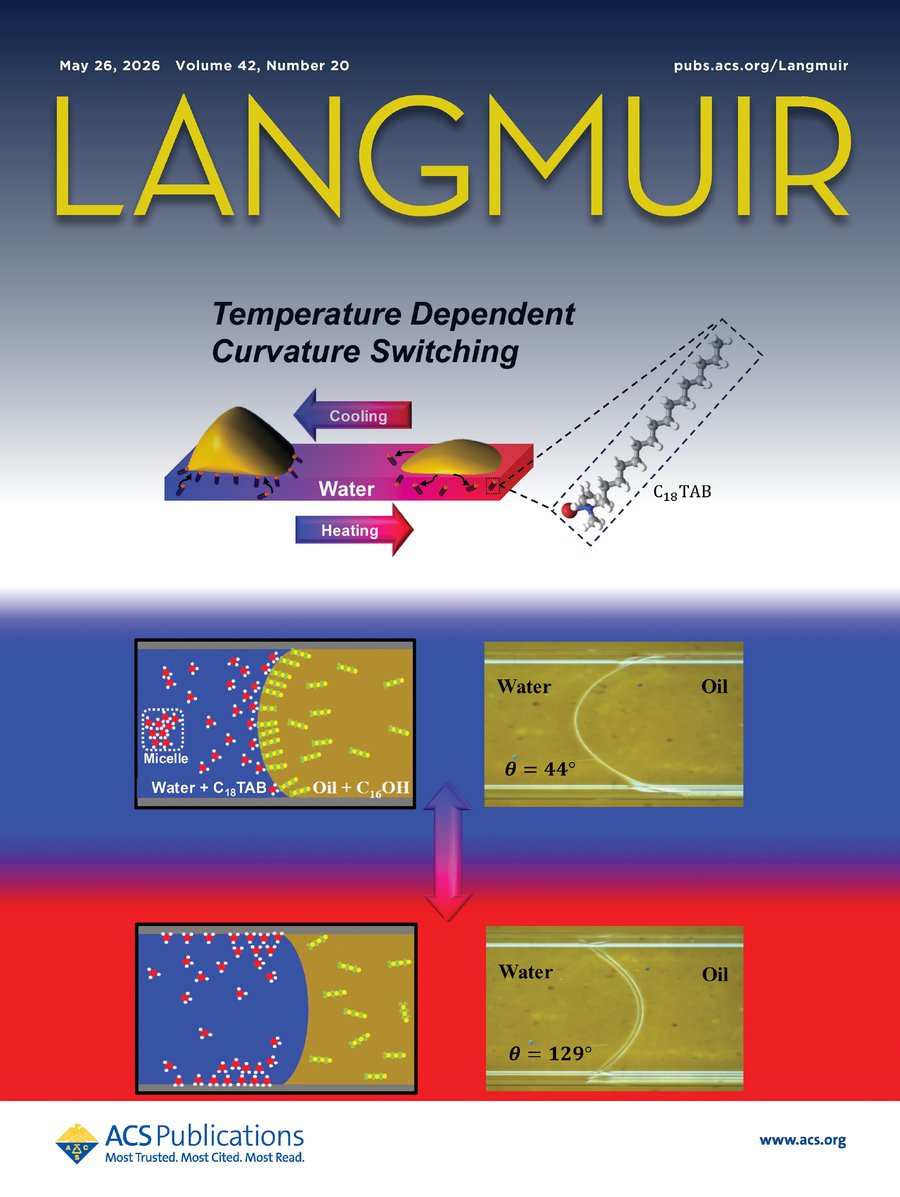
The curvature of a liquid–liquid meniscus determines how fluids wet a surface, how they move through narrow channels, and whether they are drawn in or pushed out. In most systems, this curvature is fixed once the fluids and surfaces are chosen. Being able to change it on demand, reversibly and without moving parts, would open up programmable microfluidics, adaptive thermal management, and surfaces whose wettability can be switched during operation.
Our approach
We study oil–water menisci in capillaries where each phase contains a surfactant that responds to temperature: C18TAB in the water and hexadecanol in the hexadecane. High-resolution bright-field microscopy tracks meniscus displacement, contact angle, and interfacial tension while we systematically vary:
- surfactant type and concentration,
- capillary size,
- how fast the temperature changes, and
- whether the system is being heated or cooled.
Key findings
- Reversible, tunable switching. The meniscus flips between concave and convex shapes at a transition temperature that can be tuned through surfactant composition and concentration.
- Thermal hysteresis in contact angle. Heating and cooling follow different paths. We attribute this to asymmetric adsorption and desorption kinetics and to interfacial freezing, and the effect is stronger in wider capillaries.
- Equilibrium switching. Over the range tested, the rate of temperature change has little effect on switching, which indicates the interface stays in quasi-static equilibrium at concentrations above the critical micelle concentration.
Together, these results provide design principles for programmable, reversible wettability control.
Publication
Cover article, May 26, 2026 issue: An Experimental Study of Interfacial Dynamics Control Using Temperature-Sensitive Surfactants, Langmuir 42(20), 14045–14059 (2026). A. Sarchami, S. Pakanati, A. Yasin, M. A. Jog, K. Bellur. Open access.
This work was led by PhD candidate Amirhosein Sarchami, with undergraduate researcher Saaras Pakanati and PhD student Ayaaz Yasin. It complements our computational work on pore-scale flow regime tuning, which uses the same idea of temperature-switchable wettability to control flow through porous media.
Broader relevance
Switchable wetting at liquid–liquid and liquid–solid interfaces is relevant to microfluidic valves and pumps with no moving parts, wicking structures in thermal management, emulsion and separation processes, and wet processing of surfaces where wetting and dewetting behavior has to be tightly controlled.